What makes up a mortgage payment
Learn what PITI means and see how much of your monthly mortgage payment goes toward interest, taxes, and insurance instead of the loan.
What PITI stands for
When you buy a home, your monthly housing bill covers more than just paying back the money you borrowed. Most mortgage payments wrap four separate expenses into a single monthly check. Lenders call this combination PITI, which stands for principal, interest, taxes, and insurance.
Understanding how these pieces fit together helps you plan your monthly budget. A loan quote might show a lower number at first glance, but taxes and insurance increase the final amount you owe each month.
Here is what each part represents:
- Principal: This is the portion of your payment that goes directly toward paying off the loan balance you borrowed.
- Interest: This is the fee the lender charges you for borrowing the money.
- Taxes: Local governments charge property taxes to fund public services like roads and schools. Your lender collects one-twelfth of your estimated annual tax bill each month.
- Insurance: Lenders require homeowner's insurance to protect the property against hazards like fire or storm damage. Like taxes, this annual cost is split into twelve monthly installments.
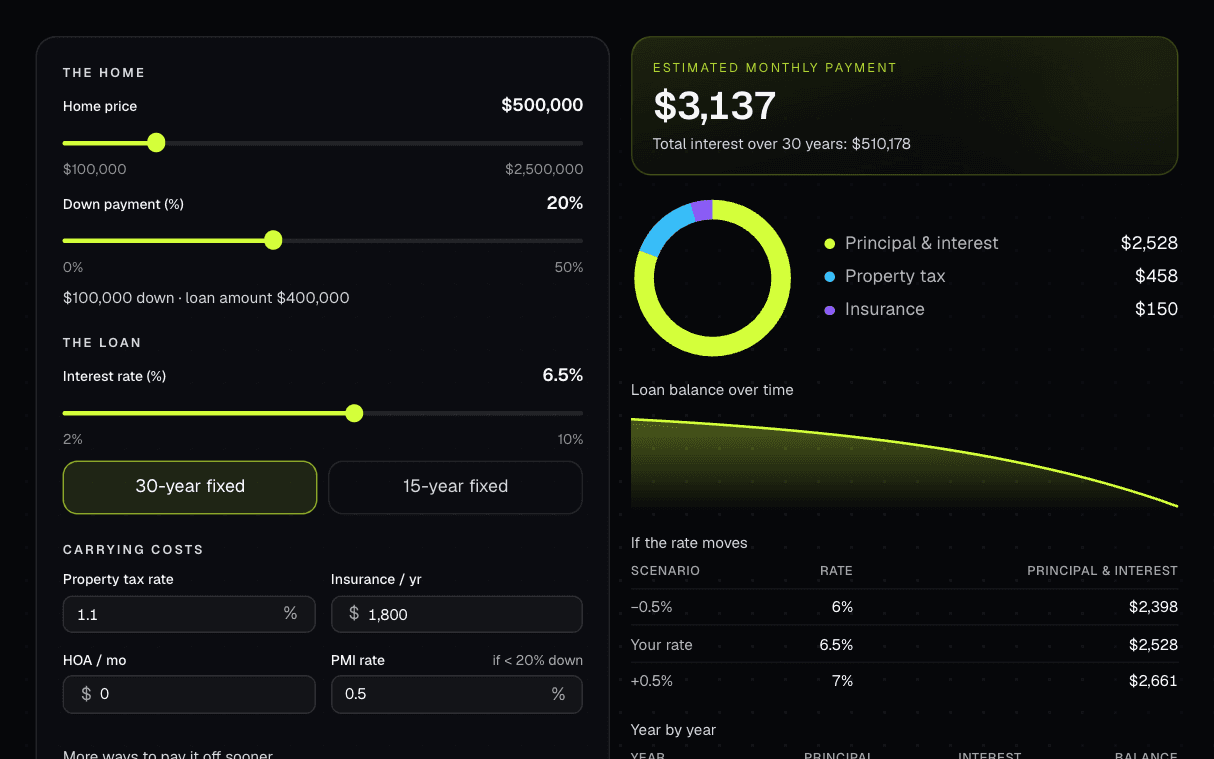
- Home price
- $500,000
- Down payment
- $100,000 (20%)
- Loan
- $400,000
- Interest rate
- 6.5%
- Term
- 30 years
- Principal and interest
- $2,528/mo
- Property taxes
- $458/mo
- Homeowner's insurance
- $150/mo
- Total interest over the loan
- $510,178
- Same home with 10% down: PMI
- $188/mo
- Same home with 10% down: total
- $3,640/mo
How much of your payment is not the loan
Many buyers assume their mortgage payment mostly pays down their property debt. In the early years of a loan, that is rarely the case. Non-loan costs take up a significant share of every check you write.
Looking at the example above, the principal and interest portion is $2,528 each month. Property taxes add $458, and homeowner's insurance adds another $150. That means $608 per month goes toward taxes and insurance alone. These are ongoing costs of owning property, not loan repayment.
Interest also takes up a substantial part of the early payments. In the example, borrowing $400,000 at a 6.5% rate over 30 years results in $510,178 in total interest charges over the life of the loan. In the first few years, only a small fraction of the $2,528 reduces the principal balance.
Extra costs: PMI and HOA dues
Your monthly bill may include additional fees depending on your down payment and the type of home you purchase.
If you put down less than 20% on a conventional loan, lenders typically require private mortgage insurance, or PMI. This insurance protects the lender if you stop making payments. In the example, putting 10% down instead of 20% adds $188 per month in PMI. That extra charge raises the total monthly payment from $3,137 to $3,640. You pay this fee until you build enough equity in the home.
Homeowners association (HOA) dues are another common expense. If you buy a condominium, townhouse, or a single-family house in a managed subdivision, you owe monthly or annual dues. These dues cover shared amenities, exterior maintenance, and community services. Lenders usually do not collect HOA dues through your mortgage payment, but they review them when deciding how much you can borrow.
How escrow accounts handle the extra parts
Lenders collect money for taxes and insurance to protect their investment. If property taxes go unpaid, the local government can place a lien on the home. If insurance lapses, damage could destroy the asset backing the loan.
To prevent these issues, lenders set up an escrow account. Each month, the lender deposits the tax and insurance portions of your payment into this holding account. When your property tax bill and insurance premiums are due, the loan servicer pays them directly to the county and insurance company.
Property taxes and insurance rates can adjust over time where you live. When they change, your lender recalculates your monthly escrow payment. That means your total monthly payment can shift slightly over the years, even on a fixed-rate loan.
Estimate your monthly numbers
You can test different home prices, down payments, and interest rates to see how each part affects your monthly total.
Use our Mortgage Calculator to see your full monthly payment breakdown.