When a mortgage refinance pays for itself
Learn how to find your refinance break-even point and why resetting your loan term changes the true cost of your mortgage.
How mortgage break-even works
Refinancing replaces your current mortgage with a new one. This process is not free because lenders charge closing costs for loan origination, appraisals, and title work. To know if replacing your loan makes sense, you must find your break-even point.
Your break-even point is the amount of time it takes for your monthly savings to cover your upfront closing costs. To find this number, divide your total closing costs by your monthly payment savings. Once you pass that date, the monthly savings become real money kept in your pocket.
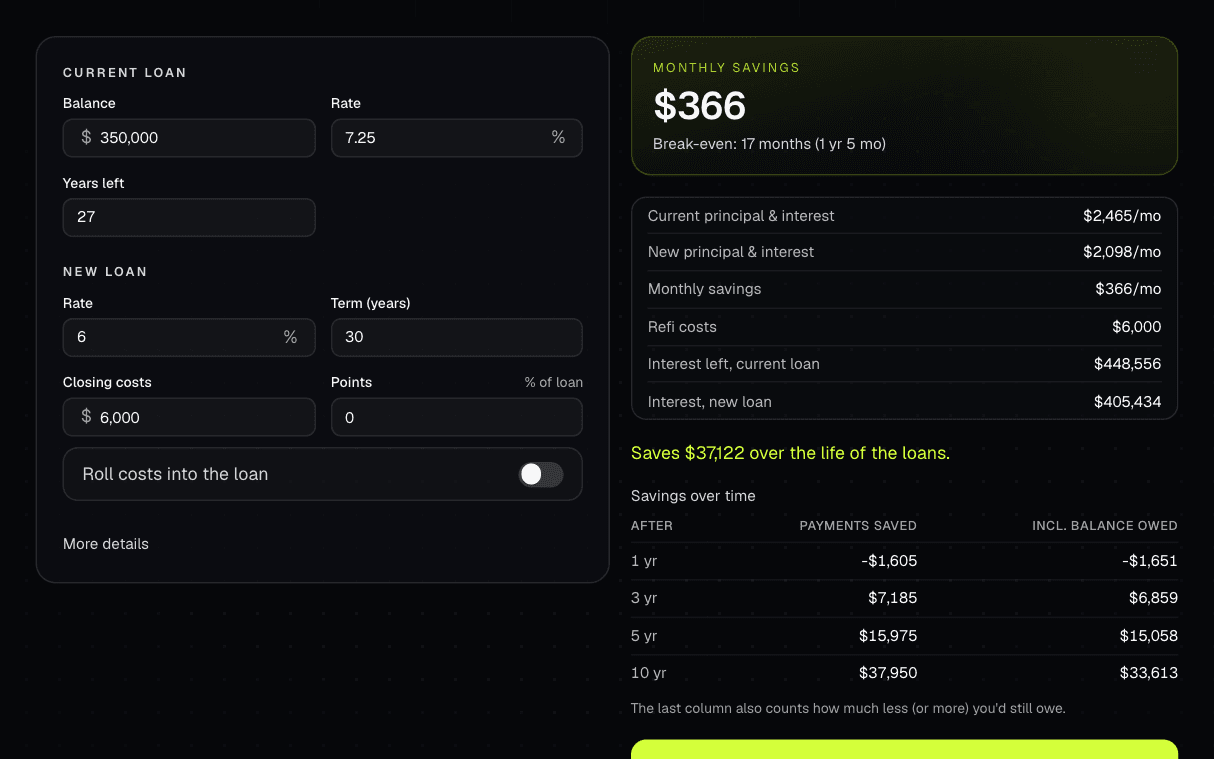
For example, imagine you have a loan balance of $350,000 at a 7.25% interest rate. Refinancing that balance to a 6% rate lowers your monthly principal and interest payment from $2,465 to $2,098. That creates a monthly savings of $366. If your closing costs are $6,000, dividing $6,000 by $366 gives you a break-even point of 17 months, or 1.4 years.
- Current balance
- $350,000
- Current rate
- 7.25%
- Years left
- 27
- New rate
- 6%
- New term
- 30 years
- Closing costs
- $6,000
- Current principal and interest
- $2,465/mo
- New principal and interest
- $2,098/mo
- Monthly savings
- $366/mo
- Break-even
- 1.4 years
The risk of resetting your loan clock
A lower monthly payment brings relief to your budget, but it does not tell the full story. Many homeowners forget to look at how many years of payments they have left. Resetting the loan term can quietly increase your long-term costs.
In the example above, the original loan had 27 years left to pay. Switching to a new 30-year loan adds three years of payments back onto the debt. Even though the interest rate drops from 7.25% to 6%, stretching the payments across 360 new months means you pay interest for a longer period.
If you only look at monthly cash flow, a refinance can look like an easy choice. When you look at the total interest paid over the life of the loan, those extra years can eat away at your savings. You must decide whether short-term monthly breathing room or paying off the home sooner matters more for your household.
How long you plan to stay in the home
Your break-even timeline only works if you stay in the house long enough to reach it. Life events, job changes, and family plans can alter your schedule.
If your break-even point is 17 months and you sell the house in a year, you lose money. You will have paid $6,000 in closing costs but only collected 12 months of savings at $366 per month. That leaves you short of breaking even.
If you know you will live in the home for several years beyond the 1.4-year mark, the refinance works in your favor. Think honestly about your plans before you sign loan paperwork. If a move is likely in the near future, paying upfront fees to lower a monthly payment rarely pays off.
Keeping your original payoff schedule
You do not have to stretch your debt over extra years when you refinance. If you want a lower rate without resetting your timeline, you have options.
- You can apply your monthly savings directly back toward the principal balance each month.
- You can ask a lender for an uneven loan term that matches the years you have left.
- You can shorten your loan term to build home equity faster, as long as your monthly budget allows for it.
Putting extra cash toward the principal helps cancel out the effect of starting a new loan term. It allows you to take advantage of the lower interest rate while staying on track with your original debt-free target date.
Running your own numbers
Every mortgage has different terms, fees, and remaining balances that shift the financial outcome. The Refinance Break-Even tool helps you see how long a refinance takes to pay for itself using your own numbers.