What you walk away with after selling your house
Learn how mortgage payoffs, commissions, taxes, and closing fees affect the cash you walk away with when you sell your home.
When you sell your home, the contract price is not the cash you receive at closing. Several expenses are deducted from the sale price before the closing agent wires your money or hands you a check. The money left over is your net proceeds.
Understanding these deductions helps you plan your next move with realistic numbers. The math begins with the final sale price, then subtracts your loan balance and regular transaction costs.
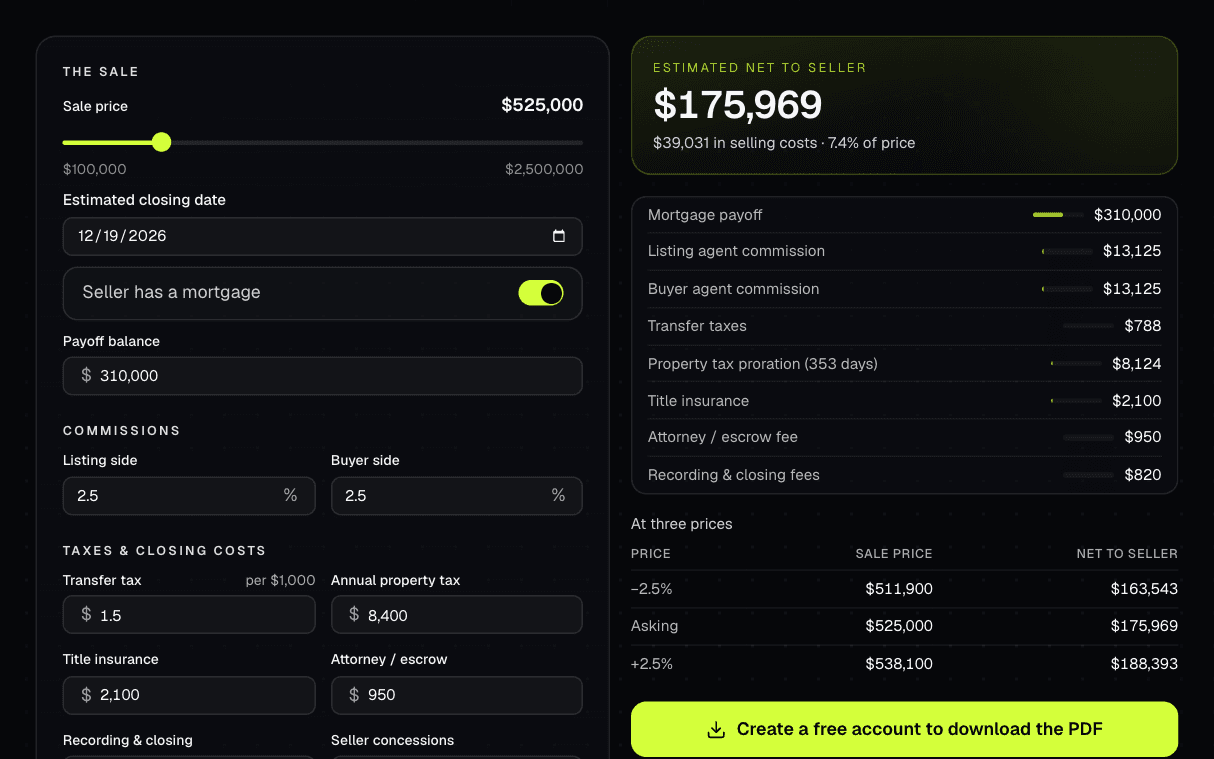
In an example sale of a $525,000 home with a $310,000 mortgage, the seller walks away with an estimated $175,969 after paying $39,031 in total closing costs.
- Sale price
- $525,000
- Mortgage payoff
- $310,000
- Commissions
- 5% total
- Closing date
- December 19
- Commissions
- $26,250
- Transfer taxes
- $788
- Property tax proration (353 days)
- $8,124
- Title, attorney and closing fees
- $3,870
- Total costs before the payoff
- $39,031
Paying off your remaining mortgage
Your mortgage payoff is usually the largest deduction from your proceeds. This is the exact amount needed to clear your home loan in full.
The payoff amount is rarely identical to the principal balance shown on your last monthly statement. Mortgages collect interest in arrears, meaning each payment covers the previous month of borrowing. Your closing agent will order an official payoff statement from your lender. That statement adds daily interest up to the date the lender receives the payoff check. If you have a second mortgage or a home equity line of credit, those balances must also be paid off at the same time.
Real estate commissions
Real estate commissions are fees paid to the brokerages involved in the transaction. These fees compensate the agents for marketing the home, handling paperwork, and managing negotiations.
Commission is typically calculated as a percentage of the total sale price. In our example, a 5% commission on a $525,000 sale equals $26,250. This fee is divided between the listing brokerage and the buyer's brokerage according to the listing agreement. The closing agent pays these fees directly out of your proceeds on closing day.
Transfer taxes
A transfer tax is a fee charged by your local government when the ownership of real estate changes hands. Depending on where you live, transfer taxes might be imposed by the city, county, state, or a combination of all three.
The tax is generally calculated as a flat rate or a small percentage based on the property sale price. In some areas, custom dictates that the seller pays the entire transfer tax, while in other places it is split with the buyer. In our sample transaction, transfer taxes come to $788.
Property tax prorations
Property taxes must be divided fairly between you and the buyer based on the days each party owns the home during the tax year. This adjustment is called a tax proration.
In many areas, property taxes are paid in arrears, which means bills arrive after the time has already passed. Because the buyer will receive the bill later for time you lived in the house, you give the buyer a credit at closing. For example, with a closing date of December 19, the seller owned the home for 353 days of that year. That results in a credit to the buyer of $8,124 deducted from the seller's proceeds.
Title and settlement charges
Closing involves legal paperwork and title research to verify that the home can be sold free of liens. A title company, escrow company, or real estate attorney handles these tasks.
You will see charges on your settlement statement for the title search, closing settlement services, and document preparation. These professionals coordinate the funding, record the new deed with the county, and distribute payments to your mortgage lender and local tax collectors. In our example transaction, title, attorney, and closing fees amount to $3,870.
Reviewing your bottom line
Once every fee is deducted from your contract sale price, the remaining funds belong to you. Knowing each line item prevents surprises when you sit down at the closing table.
You can estimate your walk-away cash by entering your sale price and loan details into the Seller Net Sheet.