Are mortgage points worth it for your loan
Learn what mortgage points cost, how they lower your monthly payment, and how long it takes to break even on the upfront expense.
How mortgage discount points work
When you apply for a home loan, your lender may give you the choice to buy discount points. A discount point is an upfront fee you pay at closing in exchange for a lower interest rate over the full life of the loan. This is often called buying down the rate.
Each point costs 1% of your total loan amount. If you borrow $400,000, one point costs $4,000, and two points cost $8,000. In return, buying points reduces your interest rate by a set amount, such as 0.25% per point. Because your interest rate drops, your monthly principal and interest payment drops as well.
- Loan
- $400,000
- Rate before points
- 6.75%
- Points
- 2 ($8,000)
- Rate drop per point
- 0.25%
- Years you keep the loan
- 7
- Payment at the note rate
- $2,594/mo
- Payment at 6.25%
- $2,463/mo
- Monthly savings
- $132/mo
- Saved over 7 years
- $3,048 net of the points
- A 2-1 temporary buydown costs
- $9,215
Finding your break-even point
The main question with points is how long you plan to keep the loan. You spend cash upfront at closing, so you need enough time with lower monthly payments to make that money back. The time it takes to recover your upfront cost is called the break-even point.
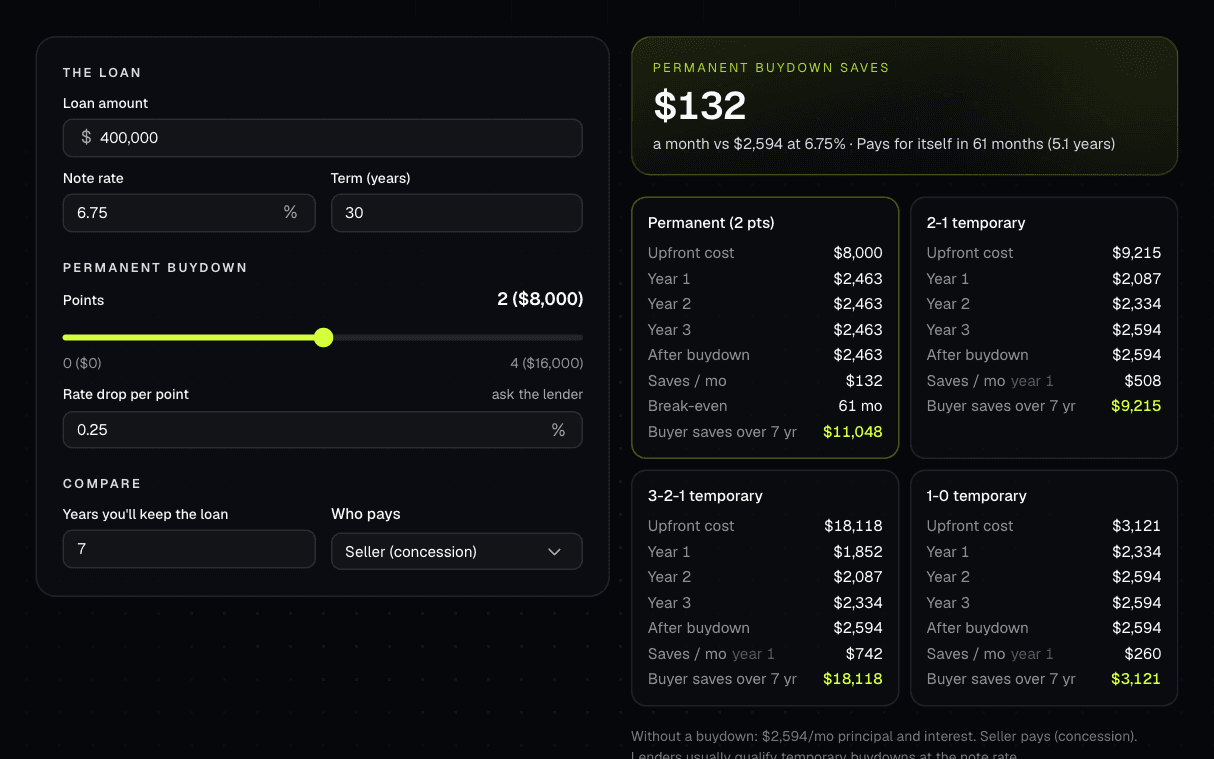
You find the break-even point by dividing the total cost of the points by your monthly payment savings. In the example shown above, paying $8,000 for two points drops your interest rate from 6.75% to 6.25%. That shifts your monthly payment from $2,594 down to $2,463, which saves you $132 per month.
Dividing $8,000 by $132 per month shows that points pay for themselves in 5.1 years. If you sell the home or refinance the loan before 5.1 years pass, you spend more on points than you recover in monthly savings. If you keep the mortgage for 7 years, your total savings add up to $3,048 net of the points you bought at closing.
Permanent points versus a temporary buydown
Another option you might hear about is a temporary buydown, such as a 2-1 buydown. While discount points permanently lower your interest rate for the entire loan term, a temporary buydown lowers your rate only for the first two years.
With a 2-1 buydown, your interest rate is reduced by 2% in the first year and 1% in the second year. In the third year, the rate returns to the original note rate of 6.75% for the rest of the loan. In our example on a $400,000 loan, a 2-1 temporary buydown costs $9,215.
Temporary buydowns provide larger payment reductions in the first two years than permanent points do. However, that payment relief ends quickly. Discount points provide a smaller monthly drop, but that drop stays in place until you pay off the home or get a new loan. Buyers often ask sellers or builders to pay for temporary buydowns as a closing credit to ease into their initial housing costs.
Deciding whether to buy points
Buying points can make sense under the right conditions, but it is not right for every buyer. You should look at your savings, your timeline, and your goals before paying upfront fees to lower your rate.
Here are the main things to consider:
- Your time horizon: If you know you will stay in the house and keep this specific loan past the 5.1-year break-even mark, paying for points can save you money. If you plan to move sooner, points are an unnecessary expense.
- Your available cash: Buying points requires extra cash at the closing table on top of your down payment and standard closing costs. If paying $8,000 leaves your emergency fund too thin, saving that cash on hand is usually safer.
- Refinance plans: If interest rates drop in the future and you refinance before reaching your break-even mark, the money you spent on points is lost.
- Seller credits: Sometimes a seller offers credits to help close a deal. Using those credits to purchase points lets you lower your monthly payment without spending your own cash.
You can test your own loan numbers and compare options using our buydown tool.