How to truly compare the costs of renting and buying
Comparing a rent check to a mortgage misses taxes, maintenance, and equity. Here is how to measure the real long-term costs of both options.
Why comparing rent to a mortgage payment fails
A common mistake is putting your current rent right next to a monthly mortgage payment. If you pay $2,400 for an apartment and the mortgage payment is $2,560, you might think owning costs only $160 more each month.
That comparison leaves out essential costs on both sides. Rent is the maximum amount you pay for shelter each month. A mortgage payment is the bare minimum you will pay.
The real costs of owning a home
When you own a home, your monthly check to the bank is only one piece of the expense. You also pay several ongoing bills that a renter never receives:
- Property taxes: Local governments charge annual taxes on your real estate.
- Homeowners insurance: Lenders require insurance to protect the structure against damage.
- Maintenance and repairs: Appliances break, roofs age, and plumbing leaks. The owner pays every bill out of pocket.
- Transaction fees: You pay closing costs when you buy the property, and you pay fees when you eventually sell it.
- Lost investment growth: The cash you use for your down payment is locked in the house. It cannot earn interest in a bank account.
The hidden cost of renting
Renting has its own set of financial trade-offs. Your landlord can raise your rent at the end of every lease term. Over several years, those small increases add up to a much larger monthly check.
Renting also produces zero ownership. When you write a rent check, that money is gone forever. You do not build any equity, and you do not benefit if property values rise in your neighborhood.
A real comparison over seven years
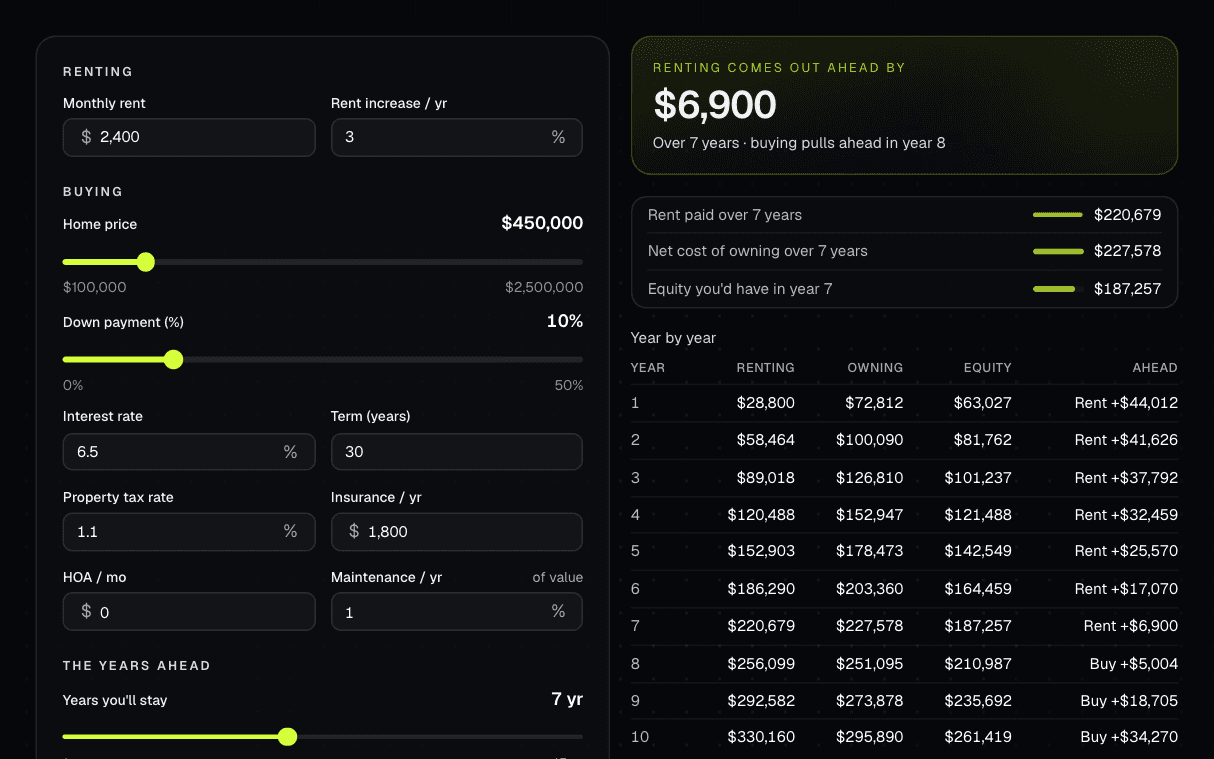
To compare both options fairly, you must look at total money out the door and total value gained over time. Consider an example of a $450,000 home compared to a $2,400 monthly rent.
The buyer puts down 10%, which is $45,000, at an interest rate of 6.5%. Rent goes up by 3% each year, and the home appreciates at 3% each year.
- Rent today
- $2,400/mo
- Rent increase per year
- 3%
- Home price
- $450,000
- Down payment
- $45,000 (10%)
- Interest rate
- 6.5%
- Appreciation per year
- 3%
- Years you stay
- 7
- Principal and interest
- $2,560/mo
- Rent paid over 7 years
- $220,679
- Net cost of owning over 7 years
- $227,578
- Equity in year 7
- $187,257
- Year buying pulls ahead
- Year 8
In this estimate, the principal and interest payment is $2,560 per month. Over 7 years, the renter pays $220,679 in total rent.
The buyer builds $187,257 in equity by year 7 through loan paydown and appreciation. Yet when you add up loan interest, taxes, maintenance, buying costs, and selling costs, the net cost of owning over those 7 years is $227,578.
Because of those heavy transaction and ownership expenses, renting comes out ahead over 7 years by $6,900. In this example, buying does not pull ahead until Year 8.
Why your timeline changes the outcome
Time is the biggest factor in the rent versus buy equation. When you buy, you pay large upfront costs to get into the loan, and you pay large fees when you sell.
If you only stay in a home for two or three years, your equity gains rarely cover those transaction fees. You end up spending more money than if you had simply rented.
As the years pass, the math tilts toward owning:
- Your principal and interest payment remains fixed for the life of the loan.
- Market rents keep rising with inflation, making your fixed payment look cheaper over time.
- With each passing year, a larger share of your monthly payment goes toward the principal balance instead of interest.
If you plan to stay in one place for a long time, the equity you build can overtake the high costs of buying and maintaining the home.
See your own numbers
An estimate depends entirely on how long you stay, the price of the home, and the cost of rent. Put your own numbers into the calculator below to find the year buying pulls ahead for you.