How your debt-to-income ratio affects your home budget
Learn how lenders use your debt-to-income ratio to set your price range and compare buying power at different debt levels.
How debt-to-income ratio works
Debt-to-income ratio is a simple comparison lenders use. It compares the money you owe each month to the money you earn before taxes. Lenders use this number to see how comfortable you will be handling a monthly mortgage payment.
Your gross monthly income is what you earn before taxes, retirement savings and health insurance come out. Lenders start with this number.
They also look at your monthly recurring debts. These are regular bills you must pay each month, like car loans, student loans, or credit card bills. Everyday living expenses like food, gas, and utilities are not counted in this debt number.
How lenders calculate the ratio
To find your ratio, a lender adds your existing monthly debts to your estimated new house payment. That new house payment covers principal, interest, property taxes and homeowners insurance, plus mortgage insurance if you put less than 20% down.
Next, the lender divides that total monthly debt figure by your gross monthly income. The result is written as a percentage. This percentage tells the lender how much of your pre-tax pay goes toward fixed debts.
A lower percentage shows that you have more room in your budget. A higher percentage means a larger part of your pay is already committed to debt payments.
- Household income
- $120,000/yr ($10,000/mo)
- Other monthly debts
- $650/mo
- Down payment
- $50,000
- Interest rate
- 6.5%
- Property tax rate
- 1.1%
- Insurance
- $1,800/yr
- Comfortable (36% DTI)
- $409,000 · $2,944/mo
- Standard (43% DTI)
- $501,000 · $3,648/mo
- Stretch (50% DTI)
- $592,000 · $4,344/mo
- Max total debt payments at 43%
- $4,300/mo
How different ratios change what you can buy
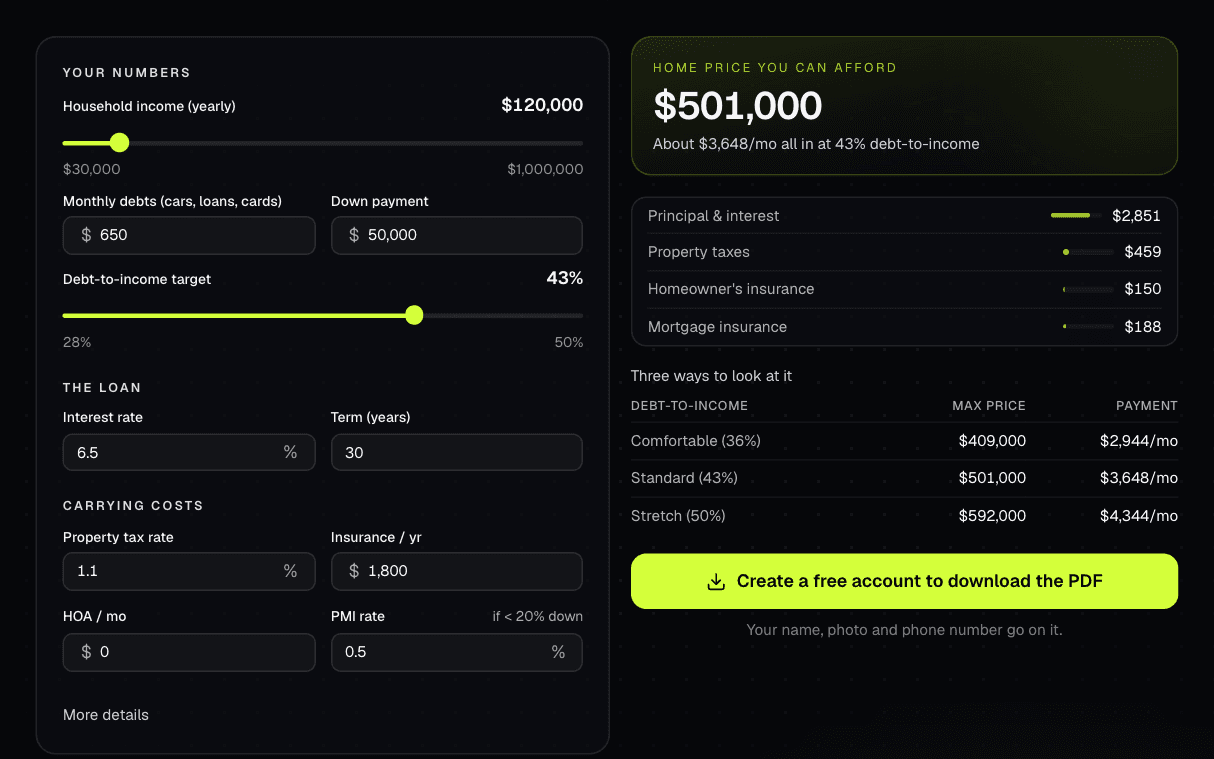
The example shows how the same income leads to different price points. In this case, a household earns $120,000 a year, which equals $10,000 a month before taxes. They carry $650 a month in other debts and have a $50,000 down payment. The interest rate is 6.5%, the property tax rate is 1.1%, and insurance is $1,800 a year.
At a 43% ratio, the maximum allowed for all monthly debt payments combined is $4,300 a month. After taking out the $650 for other debts, the remaining money goes to the house payment. That gives you a home price of $501,000 with a monthly payment of $3,648.
Your price range changes when you test different ratios:
- Comfortable (36% DTI): This targets a purchase price of $409,000 with a monthly payment of $2,944. You spend less of your gross income on housing and debt. This leaves more cash each month for daily spending, home maintenance, and family savings.
- Standard (43% DTI): This allows a home price of $501,000 with a monthly payment of $3,648. Many buyers use this benchmark to balance home size and monthly expenses.
- Stretch (50% DTI): This raises the home price to $592,000 with a monthly payment of $4,344. Exactly half of your gross income goes to debt and housing. This leaves a much smaller cushion for unexpected household repairs or personal goals.
Ways to adjust your debt-to-income ratio
You can take simple steps to change your ratio before you shop for a home. One option is to lower your existing monthly debt payments. When you pay off a balance, that monthly bill disappears.
Removing an old bill lowers your total debts. That allows more of your income to go toward your future house payment. It can help you qualify for a higher price point without any change to your income.
Another option is to increase your down payment. A larger down payment reduces the total amount you need to borrow. A smaller loan means a lower monthly payment, which keeps your overall ratio lower.
You can also choose to buy below your maximum limit. A lender may approve you at a higher ratio like 50%, but you do not have to spend that much. Choosing a lower ratio gives you more room in your monthly bank account.
Test your own monthly numbers
Finding the right balance depends on your personal budget and what makes you feel comfortable. You do not need to guess how your debts and income interact.
Type your income, debts, and down payment into the affordability calculator below to see your price range and estimated monthly costs.